Tasbih Counter Guide: The Dhikr After Prayer (33/33/34) — Fingers, Beads or App
The tasbih after prayer — SubhanAllah, Alhamdulillah, Allahu Akbar, counted to one hundred — is one of the easiest and most rewarded practices in Islam, and one of the easiest to skip when you're rushing off the mat. Here's what the post-salah tasbih is, why the count is 33/33/34, and an honest look at fingers, beads and dhikr counter apps — all three of which are valid.
What the tasbih after salah is
In well-known authentic hadith, the Prophet ﷺ taught his companions to follow each prescribed prayer with dhikr: SubhanAllah (glory be to Allah) thirty-three times, Alhamdulillah (all praise is for Allah) thirty-three times, and Allahu Akbar (Allah is greatest) thirty-three or thirty-four times. The narrations describe the hundred being completed in two established ways — either a thirty-fourth takbir, or ninety-nine counts sealed with la ilaha illallah wahdahu la sharika lah, lahul-mulk wa lahul-hamd, wa huwa 'ala kulli shay'in qadir. Both forms are authentically reported; many people simply alternate between them.
The reward attached in the hadith literature is enormous relative to the effort — forgiveness of sins even if they are like the foam of the sea, in one famous narration. Time-wise, it costs about ninety seconds. Few trades in the deen are that lopsided in your favor.
A related and equally famous practice: the Prophet ﷺ taught this same tasbih (with 34 takbirs) to his daughter Fatimah to say before sleep. Same words, second appointment — bedtime.
Why counting matters (and why we lose count)
Anyone who has done the tasbih knows the failure mode: somewhere around nineteen, your brain wanders to dinner, and you genuinely cannot say whether you're at 19 or 29. The count isn't the worship — the remembrance is — but losing the count usually means the mind left the remembrance too. A counting method is really an attention anchor: it gives your hands something to do so your heart can stay on the words. That's the honest case for every tasbih tool ever invented, from pebbles to pixels.
Fingers, beads, or app — the honest comparison
Fingers
Counting on the finger joints is the method noted in the sunnah — narrations describe the Prophet ﷺ counting tasbih on his hand, and many scholars consider fingers the preferred default for that reason. It needs no equipment, works anywhere, and the physical movement itself keeps you present. The only real drawback is longer counts: past a hundred, most people lose track of the rounds.
Beads (misbaha)
The misbaha — 33 or 99 beads on a string — has centuries of use across the Muslim world, and the majority of scholars have accepted counting aids of this kind, from the era of pebbles and knotted string onward. (A minority historically preferred sticking to fingers; if that difference matters to you, ask a scholar you trust.) Beads excel at long, meditative sessions: your thumb finds the next bead without thought. Their weakness is simply that they're never in your pocket when you want them.
A dhikr counter app
The phone is the one counter you always have. Contemporary scholars broadly treat digital counters the same way earlier scholars treated beads: a permissible tool, judged by how it's used. A good dhikr counter gives you a full-screen tap target you can press without looking, haptic feedback so you feel each count, and presets for the 33/33/34 sequence so the transitions handle themselves. The trade-off is honest: the phone carries your distractions in the same pocket. The discipline is to open the counter and nothing else — and an app with no ads or notifications begging for attention makes that much easier.
The quiet consensus across all three: the tool is not the point. Pick whichever one means the dhikr actually happens.
Hayya's dhikr counter — free, offline, silent
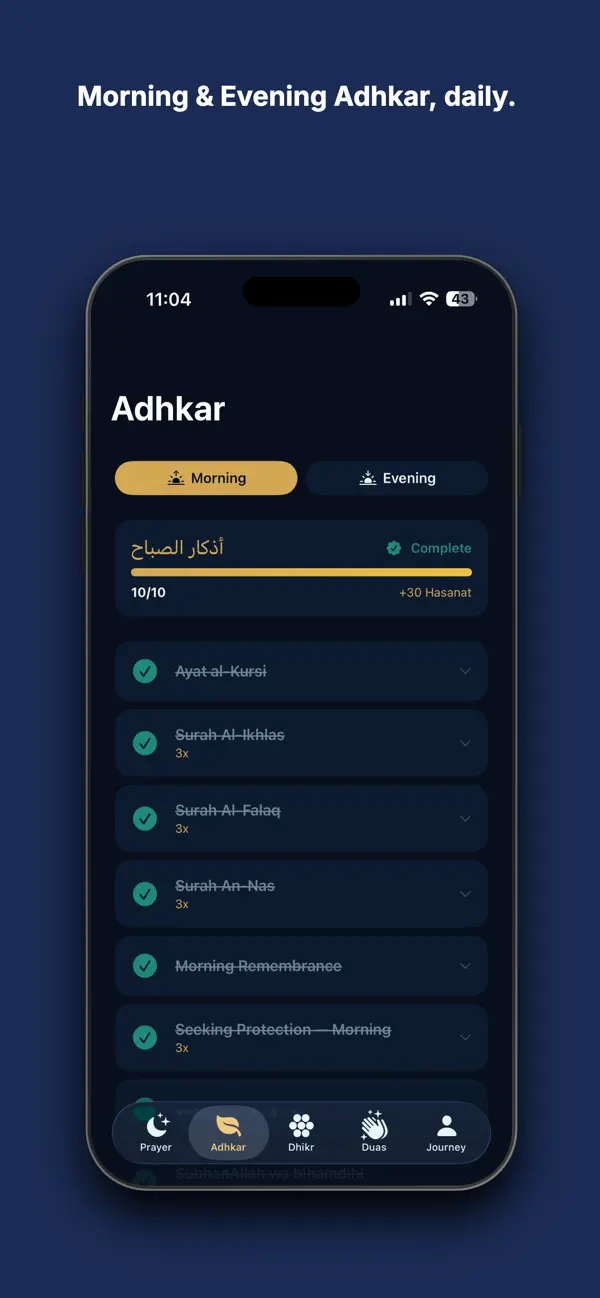
Hayya includes a dhikr counter in the free core — not Pro, free forever, like everything you need for daily worship. It sits alongside the dua library and the morning and evening adhkar checklists, so the post-salah tasbih, the daily adhkar and your own counts live in one place. And because Hayya has zero ads and zero tracking, tapping through your tasbih doesn't put you three notifications away from Instagram. Everything works offline, the whole app is 9.4 MB, and what you count stays on your device.

A tasbih counter with nothing else attached
Dhikr counter, dua library and daily adhkar — free forever. No ads, no tracking, works offline.
Download Hayya FreeMaking the tasbih stick after every prayer
The tasbih is lost in the transition — the ninety seconds between salam and standing up. So remove the transition: make a personal rule that the prayer ends after the tasbih, not after the salam. Stay on the mat; the sitting posture you're already in is the cue. If you use Hayya, the flow does the remembering for you — log the prayer, and the counter is a tap away while you're still sitting. Start with one prayer a day if a hundred counts five times over feels like a leap; Maghrib is a natural first anchor. And if your mind still drifts mid-count, that's not failure — that's the ordinary weather of dhikr. Come back to the word you're on. The practice is the returning. The same patience applies inside the prayer itself — our guide to khushu in salah picks up that thread.
FAQ
What is the tasbih after every prayer?
SubhanAllah 33 times, Alhamdulillah 33 times, Allahu Akbar 33 or 34 times — completing one hundred either with a 34th takbir or with the full la ilaha illallah statement. Both forms come from well-known authentic hadith.
Is it allowed to use a tasbih counter app?
Yes. Contemporary scholars broadly permit digital counters, just as earlier generations accepted beads and pebbles. Fingers remain the sunnah default many prefer — use whichever keeps you consistent.
Is Hayya's dhikr counter free?
Yes — the dhikr counter, dua library and morning/evening adhkar are all part of Hayya's free core, with no ads and full offline support.