Prayer Journal App or Paper? How to Keep a Salah Journal That Deepens Your Prayer
A prayer journal — on paper or in an app — is the simplest way to move from counting your prayers to feeling them. Two minutes of honest notes after salah, a few times a day, and patterns you never noticed start showing themselves. Here's the tradition behind the practice, prompts that actually work, and how to choose between a notebook and a salah journal app.
Journaling has deep Islamic roots: muhasabah
Long before habit apps, the tradition had a name for this: muhasabah — taking account of yourself. The saying famously attributed to Umar ibn al-Khattab puts it plainly: take account of yourselves before you are taken to account. Scholars across the centuries kept private registers of their deeds, their days, their shortcomings — not out of anxiety, but because what gets examined gets improved.
A salah journal is muhasabah applied to the five daily prayers. Not "did I pray?" — a tracker answers that — but "how did I pray?" Was my heart in it at Fajr? What pulled my mind away at Isha? What did I actually ask Allah for today? These are questions only you can answer, and writing them down is what stops the answers from evaporating.
What to write after each prayer
The biggest mistake is treating a prayer journal like a diary that needs paragraphs. It doesn't. One to three lines is the sustainable dose. Try rotating through prompts like these:
- Presence: On a gut level, how present was I — a 1 to 5 is fine. No judgment, just data.
- The distraction: What one thing kept pulling my mind away? (Naming it is half of defusing it.)
- One ayah: Which verse or phrase landed today, and why?
- One dua: What did I ask for in sujud or after salam?
- One intention: What will I do differently at the next prayer — slower recitation, phone in another room, arriving before the iqamah?
Over a few weeks the entries become a mirror. Maybe Fajr is your most present prayer and Asr your most rushed. Maybe work stress shows up in every Dhuhr note. You can't fix what you can't see — and now you can see it. If distraction is your recurring theme, our guide on khushu in salah goes deeper on the fixes.
A note for women keeping a prayer journal
Many prayer journals marketed to Muslim women quietly assume an unbroken month, which makes the journal itself feel like an accusation during menstruation. It shouldn't. The days you don't pray are not blank pages in your spiritual life — dhikr, dua, Quran reflection and gratitude journaling all continue, and many women find their journal gets richer in those days precisely because the structure of salah isn't carrying the weight. If you use an app, pick one that understands this: Hayya's Haid Mode pauses prayer tracking entirely, with zero penalty and zero guilt, so the journal picks up exactly where you left off. More on prayer apps designed for women →
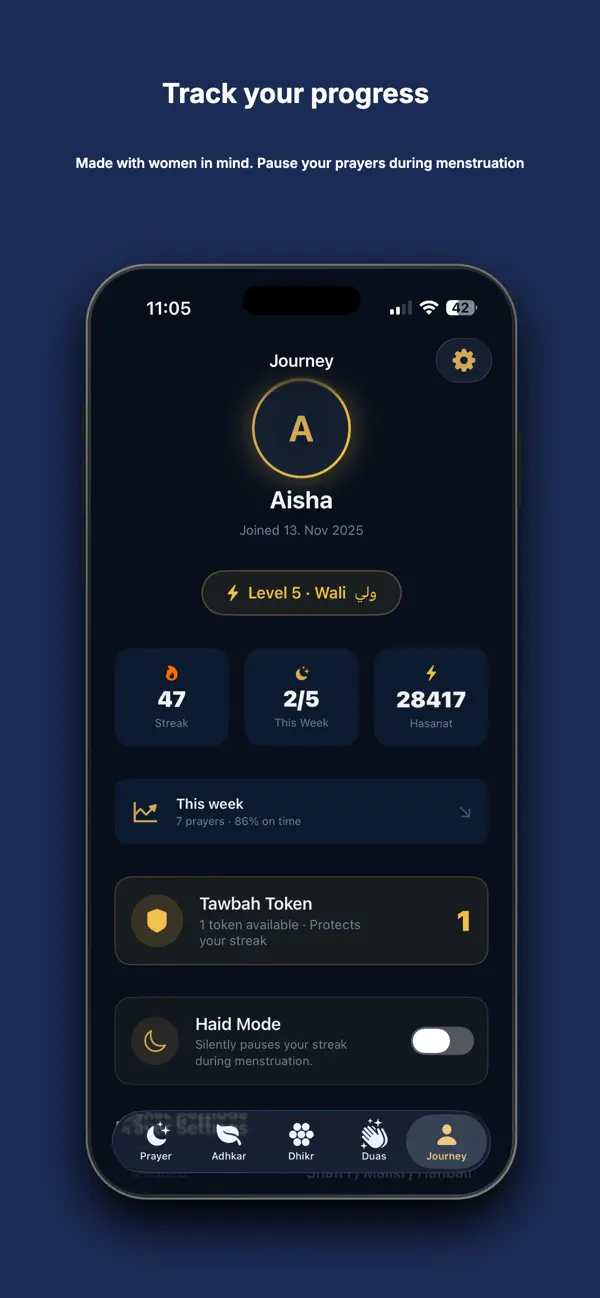
Paper journal vs prayer journal app
Both are legitimate tools; they just fail in different ways.
Paper is beautifully distraction-free — no notifications between you and your reflection — and the physical act of writing slows you down in a good way. Its weakness is logistics: the notebook is never with you at Dhuhr in the office, and after three months you can't search or spot trends without rereading everything.
An app is always in your pocket, timestamps every entry, and attaches your note to the exact prayer you just logged — so "rushed, thinking about the deadline" sits right on Tuesday's Asr forever. Its weakness is the obvious one: the same device holds every distraction you're journaling about. The fix is ruthlessness — open the app, log, write one line, close it.
Plenty of people run a hybrid: quick notes in the app after each prayer, then a slower weekly review on paper. If you like the paper side, our free printable prayer tracker templates include journal-friendly layouts.
How khushu notes work in Hayya
Hayya builds the journal into the moment you already have the app open. You log a prayer with one tap — that part is free forever — and with khushu notes, a Hayya Pro feature, you can attach a short reflection to that prayer: how present you felt, what distracted you, what you made dua for. Pro also includes curated reflections when you want a prompt rather than a blank box, and a Weekly Report Card that lays your week out honestly. To be clear about the pricing: khushu notes are part of Pro ($19.99/year or $2.99/month, 14-day free trial), while tracking, prayer times, dhikr and the rest of the core stay free. And because Hayya keeps everything on your device — no analytics, no data selling — your most private reflections stay exactly that. How Hayya handles privacy →

Log the prayer. Keep the reflection.
Free prayer tracking forever; khushu notes in Pro with a 14-day trial. No ads, everything stays on your iPhone.
Download Hayya FreeGetting started this week
Don't design a system; just begin. Pick one prayer — Isha works well because the day is behind you — and write one line after it for seven days. That's the whole commitment. If the line keeps getting written, add a second prayer. A salah journal that survives is one that asks almost nothing of you and gives back more than it asks — which, fittingly, is the shape of most good habits in the deen.
FAQ
What do you write in a prayer journal?
Keep it to one to three lines: how present you felt, what distracted you, and one dua or intention for the next prayer. It's self-accounting, not literature — two minutes is plenty.
Is keeping a salah journal an innovation (bid'ah)?
No — a journal is a personal tool for muhasabah, not a new act of worship, the same way a checklist or study notebook is a tool. If you have specific concerns, ask a trusted local scholar.
Is a paper prayer journal better than an app?
They trade strengths: paper is distraction-free and reflective; an app is always with you, searchable, and ties notes to the exact prayer. Many people use an app daily and paper weekly.