Prayer Apps & Privacy: How to Choose One That Doesn't Sell Your Data
Your prayer app knows when you pray, where you pray, and that you're Muslim. That data has been sold before — to brokers with ties to military contractors. Before downloading any Islamic app, check three things: the privacy label, the business model, and whether your location ever leaves your phone.
What actually happened
In November 2020, a widely reported investigation by Vice Motherboard found that Muslim Pro — used by tens of millions — had shared user location data with X-Mode, a broker whose clients included US military contractors. Months later, a second investigation found Salaat First selling location histories to the broker Predicio. Both apps said they stopped after the backlash — but the episode changed how many Muslims choose apps, and rightly so: follow-up studies keep finding trackers inside popular Islamic apps.
The 3-point privacy check before you download
- Read the App Store privacy label. Look for "Data Used to Track You" and "Data Linked to You". A prayer app has no business linking your identity to your location. Hayya's label lists only approximate location, not linked to you, used solely for app functionality.
- Follow the money. Free apps stuffed with ads pay for themselves somehow — usually with your data. Prefer apps funded by transparent subscriptions or one-time purchases.
- Ask where the calculation happens. Prayer times and qibla are astronomy and geometry. If an app "needs" to send your coordinates to a server for that, ask why.
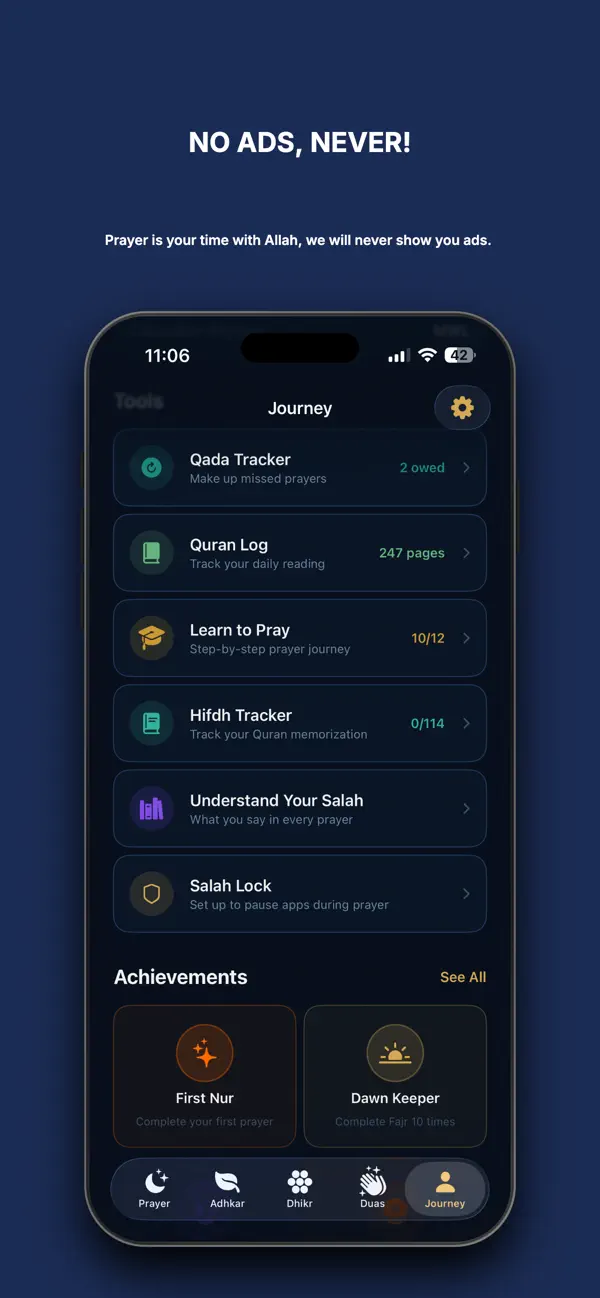
How Hayya handles your data
- On-device everything: your location is processed entirely on your iPhone to calculate prayer times and qibla — never transmitted, never stored on a server.
- No analytics SDKs, no trackers, no ads, no data brokers. There is nothing to sell and no pipe to sell it through.
- Offline-first: 12-month prayer cache, full Quran, duas, qibla and Hijri calendar work with no connection — the app is fully functional in airplane mode, which is the strongest privacy proof there is.
- Honest business model: core worship features are free forever; optional Hayya Pro (subscription or one-time lifetime) funds development. You are the customer, not the product.
- Even Salah Lock is private: the apps you choose to pause are stored via Apple's Family Controls framework and never leave your phone.
Why this matters more for worship apps
A weather app leaking your location is bad. A prayer app doing it reveals your religion, your mosque, your daily routine — data that has been used for surveillance of Muslim communities. Privacy here isn't a feature checkbox; it's part of respecting the worship itself. Your salah is between you and Allah — and it should stay that way.
A prayer app with nothing to sell but the app
No ads. No tracking. No data brokers. Ever. Your worship stays on your device.
Download Hayya FreeFAQ
How can I tell if a prayer app tracks me?
Privacy label first, then the policy: search it for "partners", "advertising" and "affiliates". If the app shows banner ads, assume an ad-tech SDK is watching.
Does a prayer app need internet at all?
Only for optional extras (like downloading recitations). Core functions — times, qibla, Quran text, duas — can and should work offline.
Is Hayya's privacy policy public?
Yes: hayyapp.com/privacy, and the App Store privacy label is on the listing.