Morning & Evening Adhkar: How to Build a Daily Dhikr Habit That Sticks
The morning and evening adhkar are short remembrances the Prophet ﷺ taught for the two hinges of the day — after Fajr and in the late afternoon. They take ten minutes, they anchor everything between them, and the only hard part is remembering every single day. That's a solvable problem.
What the adhkar include
Drawn from the Quran and authentic sunnah (collected in books like Hisn al-Muslim — "Fortress of the Muslim"), the daily remembrances commonly include:
- Ayat al-Kursi (Quran 2:255) and the three Quls (Surahs al-Ikhlas, al-Falaq, an-Nas — three times each)
- Sayyid al-Istighfar — the master supplication for forgiveness
- Morning/evening declarations — "We have reached the morning and the dominion belongs to Allah…"
- Protection supplications — seeking refuge from harm, anxiety, laziness and debt
- Counted dhikr — SubhanAllah, Alhamdulillah, Allahu Akbar (commonly ×33), La ilaha illallah, and Istighfar (×100)
When to say them
The commonly practiced windows: morning adhkar after Fajr until sunrise (many scholars allow until mid-morning), and evening adhkar after Asr until Maghrib (some extend into the early night). If you miss the window, say them when you remember — consistency over perfection.
Why most people fall off (and the fix)
Adhkar fail silently: unlike a missed prayer, nothing visibly breaks when you skip them, so weeks disappear. The fix is making the invisible visible:
- Attach them to an anchor: right after logging Fajr and Asr — prayers you already track.
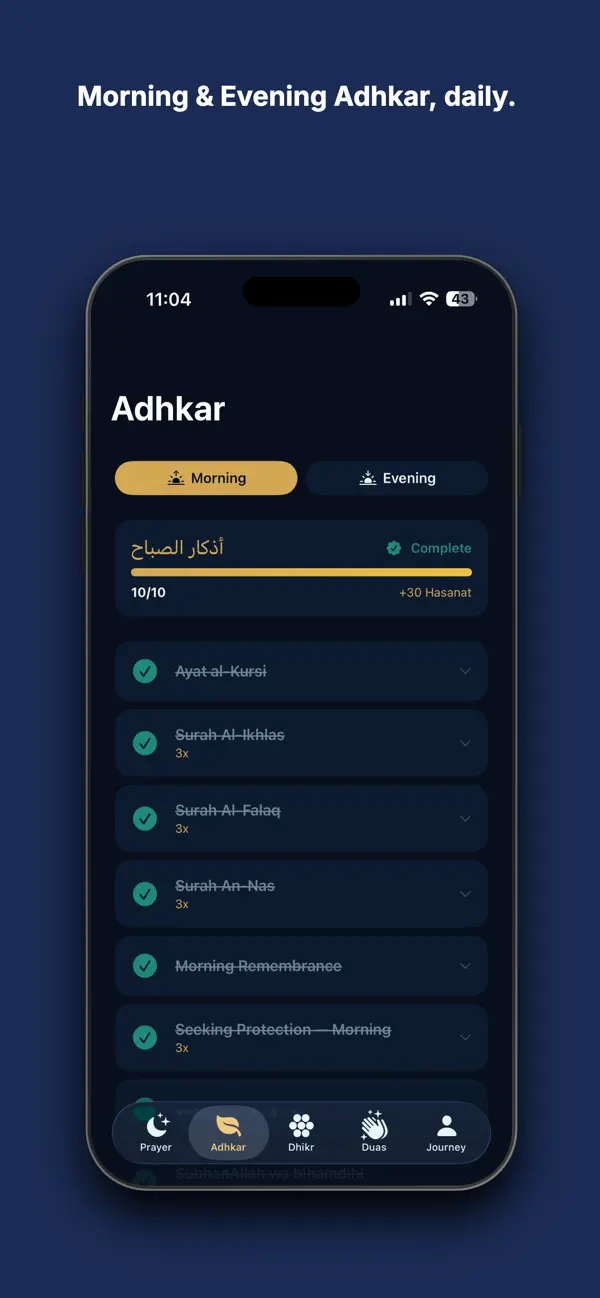
- Use a checklist, not memory: Hayya presents the morning and evening adhkar from Hisn al-Muslim as a tappable checklist with the Arabic, transliteration and translation.
- Give them their own streak: in Hayya, adhkar have a separate streak from salah — a small chain you won't want to break.
- Count without counting: the tasbih counter's haptic tap means you can do your ×33s with your eyes closed, phone in pocket. Nine presets — SubhanAllah, Alhamdulillah, Allahu Akbar, La ilaha illallah, Istighfar and more — plus custom counters for personal awrad.

Adhkar checklist + haptic tasbih, free
Morning & evening remembrances from Hisn al-Muslim, dhikr counter with 9 presets. Offline & private.
Download Hayya FreeFAQ
How long do the morning adhkar take?
Around 10–15 minutes unhurried. If mornings are tight, start with a five-minute core — Ayat al-Kursi, the three Quls and Sayyid al-Istighfar — and grow from there.
Can I say dhikr without wudu?
Yes — dhikr of the tongue and heart doesn't require wudu. (Touching a physical mushaf is a separate discussion; reciting from memory or a screen is fine per common scholarly opinion.)
Do the duas in Hayya cite their sources?
Yes — every dua in Hayya's 30+ collection includes the Arabic, transliteration, translation and its source from the Quran or sahih hadith.