How to Pray Salah: A Step-by-Step Guide for Beginners & New Muslims
Salah is prayed in units called rakats, and every rakat follows the same beautiful cycle: standing, bowing, prostrating. Once you learn one rakat, you can pray all five daily prayers. Here are the stages, step by step — no prior knowledge assumed.
Before you begin
- Wudu — the ritual washing of hands, mouth, nose, face, arms, head and feet.
- Clean place & clothes, and modest covering.
- Face the qibla — the direction of the Kaaba. Find it with your iPhone →
- The right time — each prayer has a window. How prayer times work →
The stages of one rakat
- Niyyah (intention). In your heart, intend the specific prayer — no words required.
- Takbir. Raise your hands and say Allahu Akbar ("Allah is the Greatest"). The prayer has begun.
- Qiyam (standing). Recite Surah al-Fatiha — the opening chapter of the Quran — followed by a short surah or verses in the first two rakats.
- Ruku (bowing). Bow with hands on knees, back level, saying Subhana Rabbiyal-Adhim ("Glory to my Lord, the Magnificent") three times.
- I'tidal (rising). Stand upright saying Sami' Allahu liman hamidah, Rabbana wa lakal-hamd.
- Sujud (prostration). Forehead, nose, palms, knees and toes on the ground: Subhana Rabbiyal-A'la ("Glory to my Lord, the Most High") three times. This is the closest a servant is to their Lord.
- Jalsa (sitting). Sit briefly between the two prostrations, then prostrate a second time.
- Tashahhud. After every second rakat (and in the final one), sit and recite the testimony of faith and blessings on the Prophet ﷺ.
- Tasleem. End the prayer by turning your head right, then left: As-salamu alaykum wa rahmatullah.
Rakats in each of the five daily prayers
| Prayer | Time window | Obligatory rakats |
|---|---|---|
| Fajr | Dawn until sunrise | 2 |
| Dhuhr | Midday | 4 |
| Asr | Afternoon | 4 |
| Maghrib | Just after sunset | 3 |
| Isha | Night | 4 |
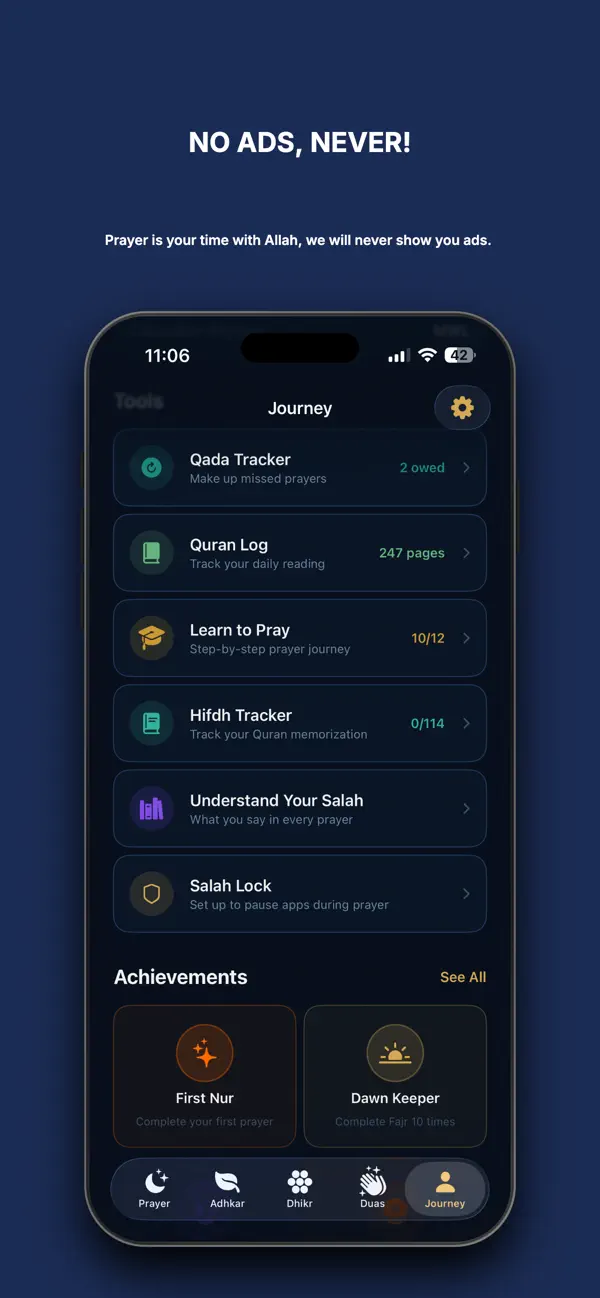
Learning salah inside Hayya
Reading a guide once won't make the movements automatic — practicing with a companion will. Hayya includes two tools built for exactly this stage:
- Learn to Pray: an interactive 9-stage walkthrough from Niyyah to Tasleem, with the Arabic text, transliteration, and the spiritual meaning of each stage — so you understand what you're saying, not just memorize sounds.
- Convert/Revert Journey: 12 progressive lessons covering wudu, each prayer posture, and all five daily prayers, with quizzes and XP rewards to pace your learning over weeks, not one overwhelming afternoon.
Alongside, the app gives you the correct prayer times for your city, the qibla direction, and a gentle streak to keep you consistent while the habit forms. Everything works offline and nothing you do is tracked — your learning stays between you and Allah.

Learn to pray, one stage at a time
Interactive salah guide + 12-lesson journey for new Muslims. Free, private, offline.
Download Hayya FreeFAQ
Do I need to pray in Arabic?
The fixed recitations (like al-Fatiha) are in Arabic, but you're allowed to learn gradually — begin with transliteration, keep the phrases short, and make personal dua in your own language. Allah knows you're learning.
What if I make a mistake mid-prayer?
Mistakes while learning don't invalidate your effort. Keep going, correct what you can, and know that scholars describe a forgetfulness prostration (sujud as-sahw) for slips — ask a local imam as questions come up.
How long until it feels natural?
Most new Muslims report the movements feel automatic within a few weeks of consistent practice — which is exactly why pairing learning with daily tracking works so well.