Mawlid 2026: 25 August (12 Rabi al-Awwal 1448) — Dates and How to Observe
Rabi al-Awwal 2026 — the third month of the Hijri year 1448 — begins on Friday, August 14, 2026 (Umm al-Qura; actual observance may vary ±1 day by moonsighting). The 12th of the month, the traditional date of the Prophet's ﷺ birth known as the Mawlid, falls on Tuesday, August 25, 2026. Here's what the month means and how to make it count.
Key dates for Rabi al-Awwal 1448 AH
- 1 Rabi al-Awwal: August 14, 2026
- 12 Rabi al-Awwal (Mawlid al-Nabi): August 25, 2026
- Month ends: Rabi al-Thani begins September 12, 2026
As with every Hijri month, the calendar date is a calculation and the moon has the final word — expect your mosque's announcement to confirm the start. The full year's table is in our Islamic Calendar 2026 guide.
Mawlid 2026 date by country
The Umm al-Qura calendar puts 12 Rabi al-Awwal 1448 on Tuesday, 25 August 2026. Countries that begin the month on a local moonsighting can land a day either side, so the observed date in 2026 is 24, 25 or 26 August depending on where you are.
| Country / region | Method | Expected Mawlid 2026 |
|---|---|---|
| Saudi Arabia | Umm al-Qura calculation | 25 August 2026 |
| UAE, Qatar, Kuwait, Bahrain | Umm al-Qura / regional sighting | 25 August 2026 |
| Egypt, Jordan, Morocco | Local sighting committee | 25–26 August 2026 |
| Algeria, Tunisia, Libya | Local sighting committee | 25–26 August 2026 |
| Pakistan, India, Bangladesh | Local sighting (often +1 day) | 26 August 2026 |
| Indonesia, Malaysia | Local sighting / hisab | 25–26 August 2026 |
| Turkey | Diyanet calculation | 25 August 2026 |
| UK, Europe, North America | Varies by mosque and body | 25–26 August 2026 |
If the exact day matters for you — a fast, a gathering, a day off — take your local mosque's announcement over any calendar, this one included.
Why Rabi al-Awwal matters
Rabi al-Awwal ("the first spring") is honored across the Muslim world as the month of the Prophet's ﷺ birth in Makkah in the Year of the Elephant. It is also, by most historical accounts, the month of his arrival in Madinah after the Hijrah and the month of his passing — the month, in other words, that frames the entire prophetic story. Unlike Ramadan or Dhul-Hijjah, Rabi al-Awwal carries no prescribed rituals: no obligatory fast, no special prayer. Its significance is relational rather than ritual — a yearly prompt to ask how well we actually know, love and follow the man ﷺ whose life defines ours.
The Mawlid: the range of scholarly views, honestly
Whether to mark the 12th with a celebration is a genuine, centuries-old scholarly difference, and it deserves an honest summary rather than a verdict from a prayer-app blog.
The view in favor: many scholars, classical and contemporary — including respected voices in the Shafi'i and Maliki traditions — held that gathering to recite the seerah, send salawat, feed people, and express gratitude for the Prophet's ﷺ birth is a praiseworthy expression of love, provided it contains nothing contrary to the sharia. Large parts of the Muslim world observe it this way, from family gatherings to public celebrations.
The view against: other scholars hold that designating the day for celebration is a religious innovation (bid'ah), since the Prophet ﷺ and the early generations did not observe it — and that the sincerest way to honor him is precise adherence to his sunnah. Communities following this view typically spend the month in ordinary worship, perhaps with extra seerah study, but without a designated celebration.
Where everyone agrees is the part that matters most: loving the Prophet ﷺ is a condition of faith, sending salawat upon him is commanded in the Quran, and studying his life is rewarded in any month. Follow the scholars and community you trust locally, and extend good assumptions to Muslims who conclude differently — this is a classic difference of opinion, not a fault line.
Practical ways to honor the month
Increase your salawat
The one act universally recommended in this month is sending blessings on the Prophet ﷺ — Allahumma salli ala Muhammad wa ala ali Muhammad. Set a daily target (100 is a common one) and count it however you like; Hayya's built-in dhikr counter works offline and keeps a running tally, so a target becomes a habit rather than an intention.

Study the seerah
Pick one biography of the Prophet ﷺ and actually finish it during the month — or one podcast series, or a chapter a night with your kids. Knowing the man makes every other act of worship more grounded. His birth month is the natural time to start.
Fast Mondays, if you can
When asked about fasting on Mondays, the Prophet ﷺ said it was the day he was born. Monday fasting is a year-round sunnah with special resonance in Rabi al-Awwal — a way of marking his birth that no scholar disputes. Our fasting tracker guide covers building the Monday/Thursday habit.
Build the consistency he ﷺ taught
The Prophet's ﷺ own standard for beloved deeds was consistency — the most beloved deeds to Allah are the most constant, even if small. There is no more direct way to honor him than five prayers, on time, every day, including the unglamorous weeks after the month ends. If that's the habit you want to leave Rabi al-Awwal with, a streak you can see helps it survive September.
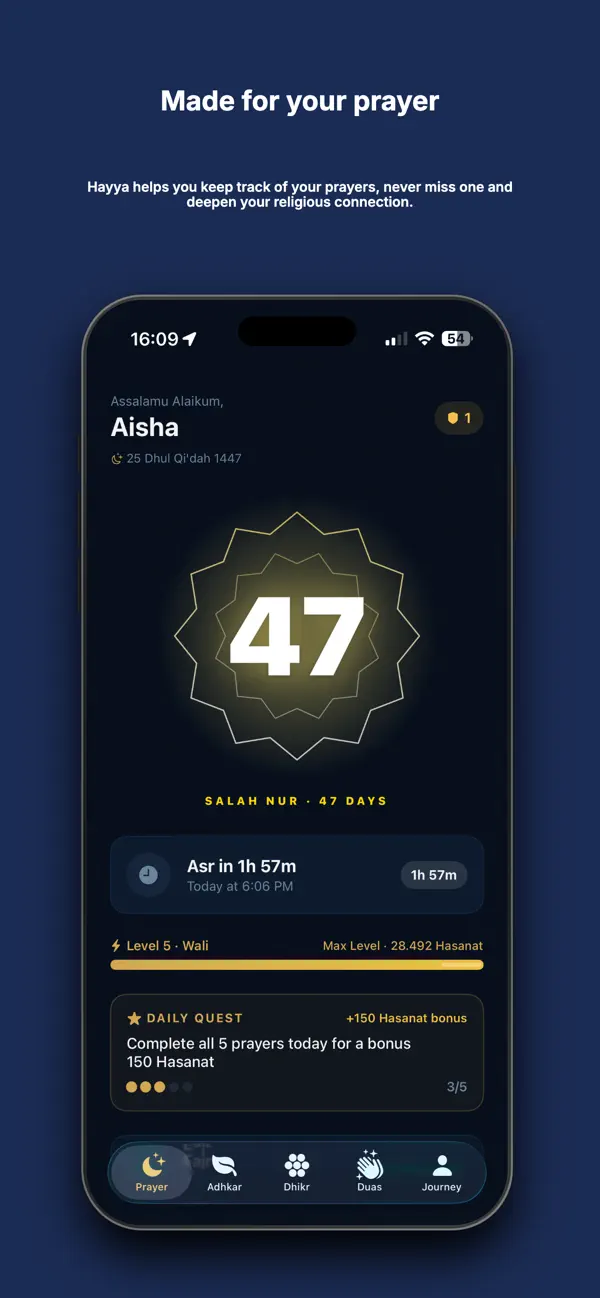

Make this the month consistency sticks
Prayer times, one-tap logging, dhikr counter for your daily salawat, and a streak with mercy. Free, no ads, offline.
Download Hayya FreeA month without rituals is an invitation
It's easy to treat non-Ramadan months as spiritual off-seasons. Rabi al-Awwal resists that: it hands you no obligations, only a person ﷺ — and asks what you'll do about him. A salawat counter ticking upward, a seerah book finished, a Monday fast, thirty days of Fajr on time: none of it is spectacular, and all of it is precisely the kind of small, steady deed he described as most beloved. Start on August 14 and aim to still be going on September 12.
FAQ
What date is 12 Rabi al-Awwal 1448?
Tuesday, 25 August 2026 by the Umm al-Qura calendar. Local moonsighting can shift it to 24 or 26 August.
Is Mawlid 2026 in August or September?
August. 12 Rabi al-Awwal 1448 is 25 August 2026. The confusion comes from the month itself running until 11 September, so Rabi al-Awwal ends in September even though the Mawlid falls in August.
When does Rabi al-Awwal 2026 start?
August 14, 2026 by the Umm al-Qura calendar, with observance possibly shifting ±1 day by local moonsighting.
When is Mawlid 2026?
The 12th of Rabi al-Awwal falls on August 25, 2026 (±1 day). How it is marked — or whether it is — varies by community.
Is celebrating Mawlid allowed in Islam?
Scholars genuinely differ: many endorse gatherings of seerah and salawat as praiseworthy; others consider a designated celebration an innovation and honor the Prophet ﷺ through his sunnah instead. Follow your local scholars, and increase salawat either way — that part is agreed.