Build a Prayer Streak: Habit Science for Never Missing a Prayer
A prayer streak is the most honest habit metric there is: five fixed appointments a day, every day, no negotiation. The good news from habit science is that salah is almost perfectly designed to become automatic — if you build the streak the right way. Here's how to never miss a prayer, and why the streaks that survive are the ones with mercy built in.
Salah is a habit scientist's dream
Behavioral research keeps returning to a simple loop: cue → routine → reward. A habit sticks when a reliable trigger leads to a consistent action that produces an immediate payoff. Most habits fail at the cue — "exercise more" has no trigger, so it never fires.
Salah comes with the cues pre-installed. Five of them, tied to the movement of the sun, at roughly the same points of your day, announced by the adhan. No habit you'll ever build has infrastructure like this. The Prophet ﷺ taught that the most beloved deeds to Allah are the most consistent ones, even if small — and the five daily prayers are consistency made into architecture.
So why do we still miss prayers? Because in modern life the cue gets buried. You don't hear an adhan in an open-plan office; the sun moves and nobody tells you. The first practical fix is simply restoring the cue: accurate, adjustable prayer notifications from times you trust. Start with getting your prayer times right →
Wire the loop deliberately
Cue: attach each prayer to something that already happens
Psychologists call these implementation intentions — pre-deciding "when X happens, I will do Y" — and in study after study they dramatically raise follow-through compared with vague goals. Write five of them, one per prayer, anchored to your real day:
- "When my Fajr alarm sounds, I get up and make wudu before checking anything on my phone."
- "When I break for lunch, I pray Dhuhr before I eat."
- "When I get home and take my shoes off, I pray Asr before sitting down."
The pattern matters: the prayer goes before the comfortable thing, because "I'll pray after I relax a bit" is how prayers die.
Routine: shrink the friction
Every step between cue and prayer is a place to leak willpower. Keep wudu easy (kept at work: socks you can wipe over per your madhhab's conditions, or simply knowing where the clean bathroom is), keep a prayer mat where you'll use it, know the qibla direction at the places you pray most. Thirty seconds of removed friction, five times a day, compounds.
Reward: make the win visible immediately
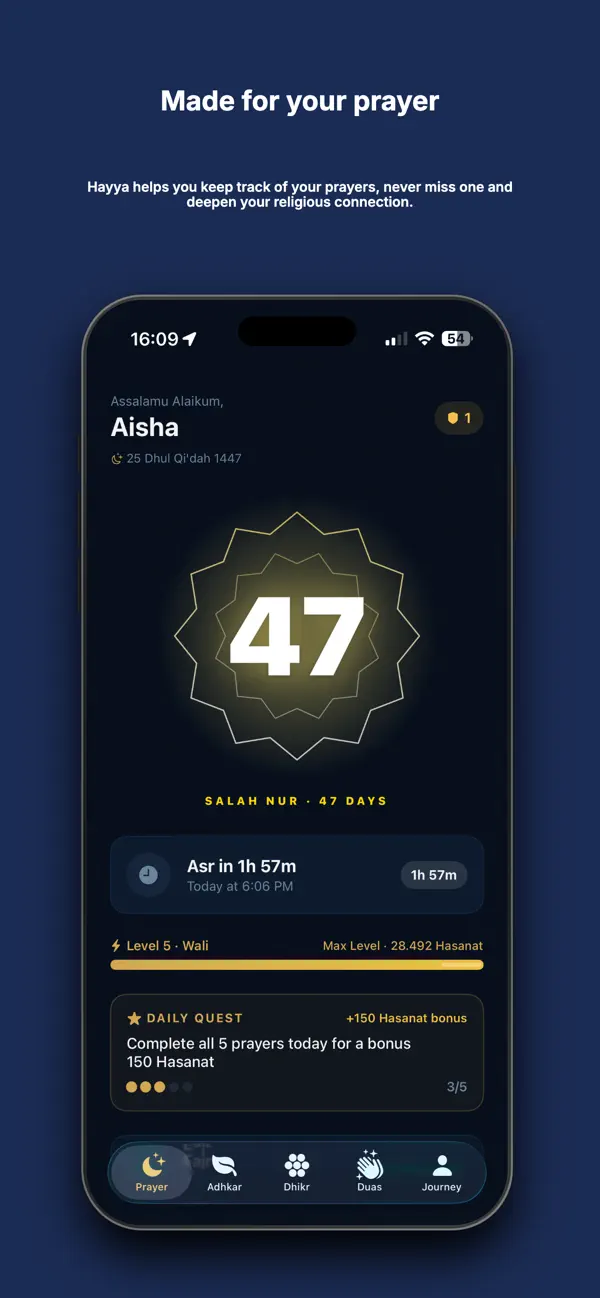
Salah's true reward is with Allah — but your habit brain also needs a small, instant, visible signal that the loop closed. That's what logging is. In Hayya, one tap marks the prayer, earns Hasanat (+75 per prayer, +150 bonus for completing all five), and feeds your Salah Nur streak. The tap takes two seconds, and it's precisely the two seconds that teach your brain "this happened, it counted."
Why most prayer streaks collapse
Here's the failure mode, and you've probably lived it: 40 good days, then one brutal Tuesday — travel, sickness, a slept-through alarm — the streak resets to zero, and something in you quits. Psychologists call the mechanism all-or-nothing thinking (its uglier cousin is the "what-the-hell effect"): once perfection is broken, the brain concludes the whole project is broken and stops trying. The streak, which existed to protect the habit, becomes the reason you abandon it.
Notice what actually happened, though. One missed prayer out of 200 is a 99.5% record. The habit is intact; only the number broke. Any streak system that can't tell the difference between a bad day and a bad Muslim is measuring the wrong thing.
Streaks with mercy: how Hayya designs around the collapse
Hayya's answer is to build the mercy into the mechanics rather than leaving you to negotiate with a broken counter:
- Tawbah Tokens — one per week, protecting your streak when life wins a day. The name is the point: returning after a slip is the tradition. That is not failure — that is Tawbah in action.
- Haid Mode — for women, tracking pauses completely during menstruation. No penalty, no broken streak, no asterisk, because not praying in those days is obedience, not omission.
- The Qada tracker — a missed prayer isn't deleted from reality by a reset counter; it's made up. Logging it as qada turns a miss into a to-do instead of a verdict.
Pair the token with the habit-science classic: never miss twice. One missed prayer is a data point; two in a row is the start of a new pattern. Spend your energy on the very next prayer, not on mourning the counter.

Start a streak that forgives
Salah Nur streak, Tawbah Tokens, Haid Mode and one-tap logging — free forever. No ads, no tracking.
Download Hayya FreeA realistic 30-day plan
- Days 1–7: Fix your cues. Set up notifications with the right calculation method, write your five implementation intentions, log every prayer — including the ones you miss. Honest data first.
- Days 8–14: Attack your weakest prayer only. For most people it's Fajr (see our Fajr guide) or Asr. Everything else just keeps ticking.
- Days 15–30: Protect the streak, not perfection. Use never-miss-twice, log qada the same day, and let a Tawbah Token absorb the one day that goes sideways.
Research on habit formation suggests real automaticity takes about two months on average — the famous 21 days is a myth — so treat day 30 as the midpoint, not the finish line. Somewhere around then, something quietly flips: you stop deciding to pray and start simply praying. The streak was never the point. It's the scaffolding that holds the wall until the wall can stand.
FAQ
How long does it take to build a prayer habit?
On average about two months to feel automatic, with wide variation between people — the 21-day rule is a myth. The first two or three weeks take real effort; it gets easier from there.
What should I do when I break my prayer streak?
Never miss twice: make the next prayer on time and log the missed one as qada. In Hayya, a weekly Tawbah Token can protect the streak itself — one hard day shouldn't erase months of progress.
Is it wrong to use streaks and points for worship?
A streak is a means, like a memorization schedule — the prayer and intention remain between you and Allah. If the number ever starts mattering more than the prayer, that's your cue to recalibrate, not necessarily to quit tracking.