Prayer App Without Ads: Why Ad-Free Matters for Your Salah
You open your app to check Maghrib time and a video ad plays first. If you've gone looking for a prayer app without ads, you already know the problem: most free Muslim apps are funded by advertising, and advertising has a cost you don't see on the price tag. Here's why it happens, what it does to your worship, and how to find a genuinely ad-free prayer app.
Why are prayer apps full of ads?
It isn't malice — it's a business model. Servers, updates and App Store fees cost money, and the fastest way to fund a free app is to plug in an ad network. But ad networks pay per impression and per tap, which quietly reshapes the app around you seeing more ads: interstitials before prayer times load, banners under the qibla compass, "watch a video to unlock" prompts. The app's incentive shifts from serving your salah to holding your attention.
The deeper issue is what powers those ads. Ad networks work best with data — device identifiers, rough location, usage patterns. A prayer app knows things most apps never will: your religion, when you wake for Fajr, roughly where you are five times a day. Several Muslim apps have been publicly reported over the years for passing location data to third-party brokers. That is a serious amanah to hand to an advertising company. Our privacy guide covers this in depth →
What ads cost you during worship
Think about when you open a prayer app: right before you pray. It's the one moment you're deliberately setting the dunya aside and trying to gather khushu — presence of heart. An autoplay ad in that moment isn't a minor annoyance; it's a distraction engine firing at the exact time you're trying to be least distracted. Some users report seeing ads for haram products — gambling, alcohol, immodest content — inside Islamic apps, because ad networks target the user, not the context.
There's a practical cost too. Ad-heavy apps are bigger, slower and hungrier for battery and data, and many need a connection just to show you today's times. An ad-free app can stay small and work offline.
How to spot a genuinely ad-free prayer app
"No ads" in a screenshot caption isn't proof. Before you download, check three things on the App Store listing:
- The privacy label. Scroll to "App Privacy" on the listing. "Data Used to Track You" and "Data Linked to You" sections mentioning identifiers, location or usage data are the fingerprints of an ad or analytics stack. The best answer is "Data Not Collected."
- The business model. A free app with no visible way to make money is usually monetizing you. A trustworthy app is upfront: here's what's free, here's the optional paid tier that keeps the lights on.
- The size and offline behavior. Ad SDKs add weight. An app that is tens of megabytes larger than its features justify, or that breaks without a connection, is probably phoning home.
How Hayya stays ad-free
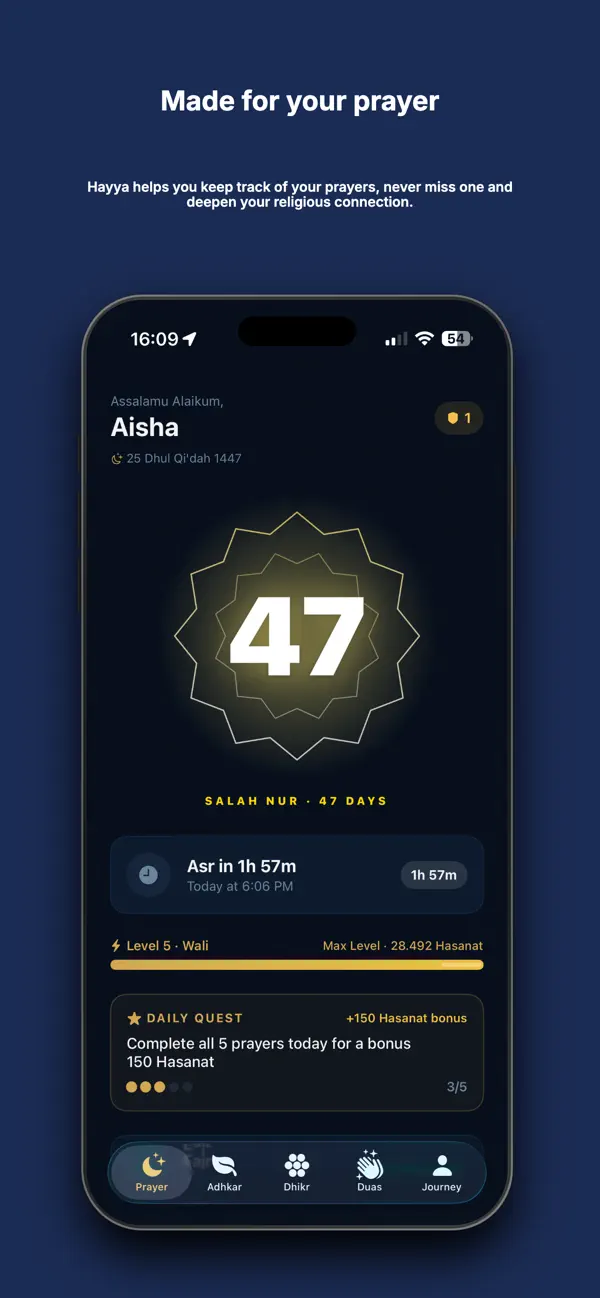
Hayya was built on a simple position: your prayer life is not advertising inventory. There are no ads anywhere in the app, no analytics SDKs, and no data selling — your location never leaves your device, because prayer times are computed on the phone itself and cached twelve months ahead. The whole app is 9.4 MB.
What pays for it? Hayya Pro — an optional subscription at $19.99/year or $2.99/month, with a 14-day free trial, that adds Home and Lock Screen widgets, a Weekly Report Card, khushu notes and curated reflections. Everything core to worship — prayer times, one-tap logging, the Salah Nur streak, qibla compass, dhikr counter, dua library, adhkar, fasting tracker and Hijri calendar — is free forever, for everyone. Subscribers fund the app so nobody has to watch an ad before Fajr. That alignment matters: Hayya's incentive is to be worth keeping, not to maximize the minutes you spend staring at it.

Zero ads. Zero tracking. Free forever.
Prayer times, tracking, qibla, duas and dhikr — all free, with no ad in sight. iPhone, 9.4 MB.
Download Hayya FreeFree with ads vs. free forever: an honest comparison
An ad-funded app is "free" the way commercial radio is free — you pay in attention and data. That trade might be acceptable for a game. For an app you open at your most spiritually vulnerable moments, it's worth asking whether the price is right. A Premium-funded model flips the equation: most users pay nothing and see nothing, and those who can afford a small subscription carry the cost for everyone else. In a sense, the Pro subscribers are doing something quietly generous — keeping worship tools clean for the whole community.
Whichever app you choose, the checklist stands: read the privacy label, understand the business model, and never accept an interstitial between you and your prayer.
FAQ
Is there a truly free prayer app without ads?
Yes. Hayya's core worship features — prayer times, prayer logging, streaks, qibla, dhikr, duas and the fasting tracker — are free forever with zero ads and zero tracking. Optional Pro extras fund the app instead of advertising.
Why do prayer apps have so many ads?
Ad networks are the default way to fund a free app, and they pay per view — which pushes developers to show more ads and share more device data. The App Store privacy label tells you what an app really collects.
How does Hayya make money without ads?
Through Hayya Pro, an optional subscription ($19.99/year or $2.99/month, 14-day free trial) that adds widgets, a weekly report card and other extras. Subscribers fund the app, so there's no ad network anywhere in it.